

Recycled Rubber and the Circular Economy: Prismi's Role
ECONOMIA CIRCOLAREPrismi transforms vulcanized rubber industrial scraps into certified secondary raw materials, making a concrete contribution to circular economy principles. Our products recycled rubber granules, powders and acoustic rolls, comply with EU Green Public Procurement criteria and support the ESG mass balance of purchasing companies.
We have operated under this model since 1990, before it became regulatory requirement.
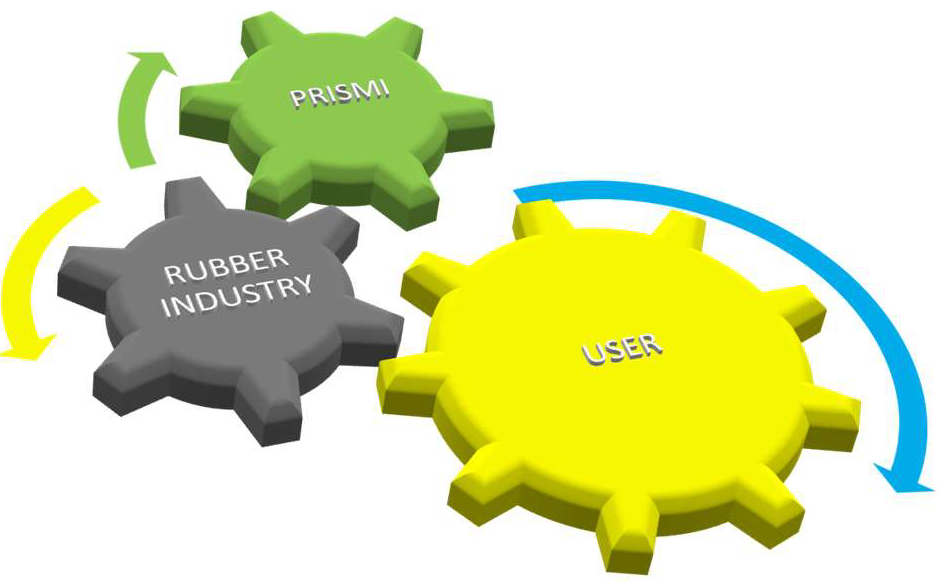
What is the Circular Economy and Why Rubber Matters
The circular economy replaces the linear “make-use-dispose” model with a closed loop in which materials are recovered and reintroduced into the production cycle.
For vulcanized rubber this is particularly relevant: industrial pre-consumer rubber scraps represent over 120,000 tonnes per year in Italy alone, a large proportion of which still ends up in landfill.
Recycling vulcanized rubber is the practical means to close this loop: scraps become granules and powders that feed new industrial production, reducing virgin rubber consumption and overall environmental impact.
Prismi and Extended Producer Responsibility
Under the principle of Extended Producer Responsibility (EPR), established by the EU Circular Economy Action Plan, manufacturing companies are required to account for the environmental impact of their products throughout the full life cycle, including end-of-life production scraps.
Prismi operates as an authorised recovery facility, transforming rubber scraps into certified secondary raw materials.
Companies that deliver their scraps to Prismi meet their environmental compliance obligations and can document the recovery performed for their sustainability reporting.
Prismi Certifications for Circular Economy Compliance
Prismi holds a Minimum Recycled Content certification across the entire product range. This enables purchasing companies to: — Prepare a mass balance to certify their finished product’s compliance with EU Green Public Procurement (GPP) requirements — Document recycled material use for public tender submissions and ESG reporting — Demonstrate compliance with the DNSH (Do No Significant Harm) principle under EU taxonomy and recovery plan frameworks Full traceability of delivered and recycled material is guaranteed for every production batch.
FAQ | Rubber Recycling and Circular Economy
Can rubber production offcuts be part of the circular economy?
Yes. Offcuts delivered to an authorized company under ordinary procedures (Art. 208 of Legislative Decree 152), and processed into powders or granules to obtain secondary raw materials, are classified as circular economy products.
Can recycled rubber granules and powders be certified?
Yes. Our company holds a Minimum Recycled Content certification across the entire product range. A company that orders and purchases our material can prepare a mass balance to certify its product’s compliance with CAM requirements
Does Prismi's recycled rubber comply with DNSH requirements?
Yes. Prismi products are traceable and certified as non-hazardous secondary raw materials, compliant with the Do No Significant Harm (DNSH) principle required under EU taxonomy frameworks and national recovery plans for recycled material supplies.